From Persecution to Settlement – Early Quaker Communities in America
Religious violence and legal harassment drove thousands of English Quakers across the Atlantic during the latter half of the seventeenth century. The Quaker Act of 1662 made their gatherings criminal offenses, and imprisonment was common. Colonial North America offered something England would not: the possibility of practicing faith without state interference.
William Penn and the Promise of Pennsylvania
Granted a royal charter in 1681, William Penn established Pennsylvania explicitly as a refuge for persecuted religious minorities. His "Holy Experiment" attracted Quakers from England, Wales, and Germany almost immediately. Philadelphia became the center of Quaker civic and spiritual life, structured around the Meeting for Worship – a gathered silence in which members waited for the inward light to move them to speak.
Settlements Beyond Pennsylvania
Rhode Island, founded by Roger Williams, had welcomed Quakers as early as the 1650s. New Jersey also received significant Quaker settlement before Penn's charter was granted. Across these communities, plain dress and plain speech marked members as distinct from their neighbors, reinforcing both spiritual identity and communal boundaries.
Migration Patterns and Family Networks in Quaker Records
Family ties shaped Quaker migration far more than individual ambition. When Friends relocated from Pennsylvania to the Carolina backcountry or westward into Ohio, they rarely traveled alone – entire kin networks moved together, settling near established Meetings wherever possible.
Certificates of Removal and What They Reveal
When a Quaker family relocated, their home Meeting issued a certificate of removal – a formal document transferring membership to the receiving Meeting. These certificates recorded names, destinations, and dates, creating a paper trail that historians now use to trace migration routes with unusual precision. A single certificate might connect a family in Burlington, New Jersey, to a new settlement in Guilford County, North Carolina.
Marriage Records and Meeting Minutes as Migration Evidence
Marriage records required witnesses, often numbering thirty or more, and those witnesses were themselves community members whose names appear across multiple records. Meeting minutes documented arrivals, departures, and disciplinary matters, collectively mapping how communities expanded along settlement frontiers across successive generations.
Why Quaker Archives Still Matter Today
Scattered across historical societies, university libraries, and regional meeting houses, Quaker records form one of the most detailed documentary traditions in American religious history. Monthly meeting minutes tracked membership, recorded disputes, and noted when families relocated – often naming the specific settlement they moved to. Birth, death, and marriage certificates were maintained with unusual consistency, making these archives genuinely useful for genealogical research. Disciplinary records, sometimes called "disownment notices," reveal how communities enforced shared values around slavery, military service, and plain living.
Historians studying colonial Pennsylvania or the settlement of the Carolina backcountry regularly rely on these materials to reconstruct migration patterns that civil records alone cannot explain. A researcher tracing an 18th-century family from Burlington, New Jersey, to the Carolinas might find the entire journey documented across three separate monthly meeting records.
Preserving these documents matters because they capture how Quaker communities shaped land use, civic governance, and social reform across generations – well beyond any single theological question.
Quaker Records Keep Community History Alive
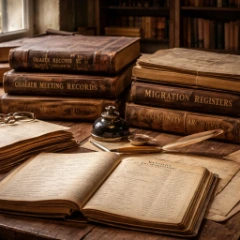
Preserved meeting records, migration registers, and community archives form the connective tissue between Quaker religious practice and the broader story of American settlement. Births, marriages, deaths, and disciplinary proceedings were documented with unusual consistency across Monthly Meetings from Pennsylvania to the Carolinas, creating an archival trail that historians and genealogists still rely on today. These documents were never purely administrative. They captured the movement of families, the boundaries of communities, and the quiet persistence of a faith that shaped regional life in ways far beyond its numbers. Repositories like Haverford College's Quaker Collection and the Friends Historical Library at Swarthmore hold thousands of such records, many dating to the seventeenth century. Understanding Quaker history in America means recognizing that migration, settlement, worship, and recordkeeping were inseparable – and that these surviving documents remain among the most reliable windows into early American community life.